Cancun Travel Advisory 2026:
The Full History, Facts, and What Level 2 Really Means
Many travelers searching for the Cancun Travel Advisory 2026 want to understand what Level 2 actually means and whether Cancun remains safe to visit.
Last Updated on March 3, 2026 by MeganWhen headlines appear, confusion spreads. As a result people panic.
Many travelers assume the advisory system began recently. However, it did not begin in 2025. In fact, it did not begin with Mexico - and it certainly did not begin with Cancun.
To understand the Cancun Travel Advisory 2026, we need to start at the beginning.
What Is the Cancun Travel Advisory 2026?
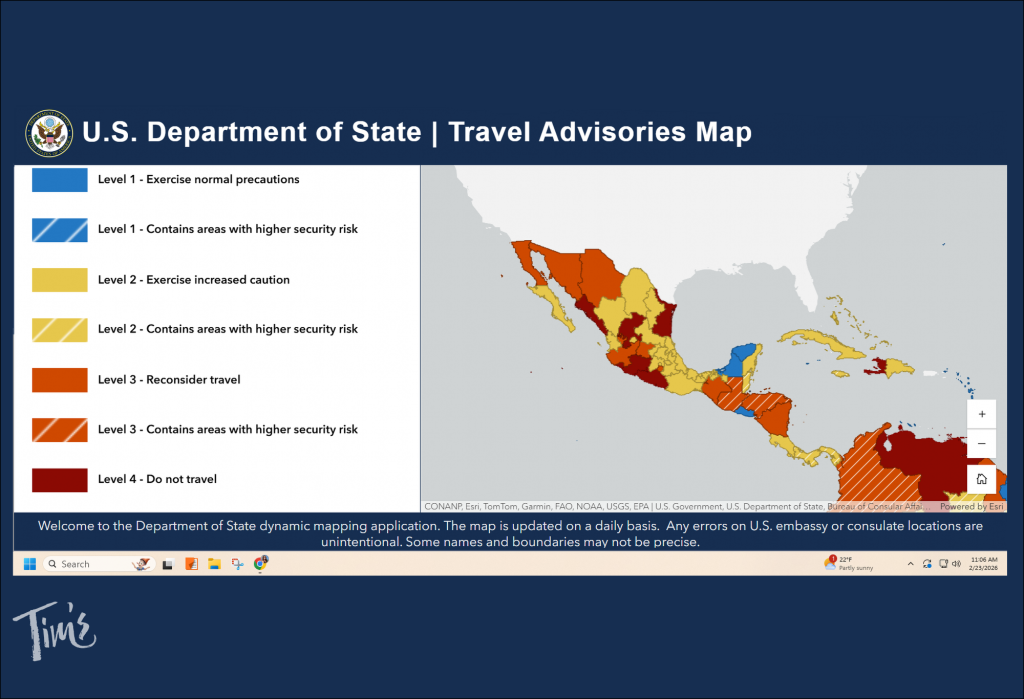
The Cancun Travel Advisory 2026 remains Level 2: Exercise Increased Caution under the system used by the U.S. Department of State. Quintana Roo - the state that includes Cancun - has held this Level 2 advisory for several years.
In 2025, the advisory language was updated after certain Mexican cartels were designated as Foreign Terrorist Organizations. However, the advisory level for Cancun did not increase.
As a result, Cancun continues operating under the same Level 2 travel advisory that existed decades prior to 2025.

Official Source of the Cancun Travel Advisory
The official travel advisory for Mexico is issued by the U.S. Department of State and published on the State Department’s travel website.
Travel advisories are reviewed and updated periodically to reflect new intelligence assessments, international security classifications, and policy changes.
The most recent advisory update for Mexico occurred on August 12, 2025, when the State Department updated risk indicator language following the designation of certain Mexican cartels as Foreign Terrorist Organizations.
Importantly, that update did not change the advisory level for Quintana Roo, the Mexican state that includes Cancun.
Travelers can always review the most current advisory directly on the official U.S. government website.
How Often Travel Advisories Change
Travel advisories are not static documents. Instead, the U.S. Department of State reviews them regularly as global conditions evolve.
Advisories may be updated when:
• security conditions change
• government policies shift
• international terrorism classifications are modified
• major natural disasters occur
• health or public safety risks emerge
However, not every update changes the advisory level itself.
Sometimes the update only clarifies language, adds risk indicators, or reflects changes in federal policy. For example, the August 12, 2025 update to the Mexico advisory added terrorism indicators after cartel designations but did not change the advisory level for Quintana Roo.
Because of this, travelers should look at both the advisory level and the reason for the update before interpreting headlines about travel warnings.
Understanding how travel advisories evolve helps travelers place updates in proper context rather than assuming that a destination suddenly became unsafe.
Travel advisories can also be updated during busy travel seasons such as Spring Break in Cancun, when many travelers review safety information before planning their trips. However, these updates are not tied to tourism cycles. Instead, the U.S. Department of State updates advisories whenever new policy, intelligence, or new safety information becomes available.
1978: The First U.S. Travel Warning System
In 1978, the U.S. Department of State created the first modern travel warning system.
During the 1970s, airline hijackings increased. International terrorism rose. Political instability spread across several regions.
Therefore, the State Department created a formal way to warn American travelers.
Two tools were created:
- Travel Warnings - were issued to disseminate information quickly about terrorist threats and other relatively short-term conditions overseas that pose significant risks to the security of American travelers.
- Public Announcements - were issued when the State Department recommends that Americans avoid travel to a certain country because the situation is dangerous or unstable.
That is why that system remained in place for nearly 40 years.
2001: After 9/11
On September 11, 2001, the United States still did not use numbered advisory levels.
Instead, the government issued a “Worldwide Caution.” and as a result Travel Warnings expanded. Security language increased globally. Click here for todays Worlwide Caution.
At the same time, there was still no Level 1 - Level 4 structure in place.
2018: The Four-Level System Begins
On January 10, 2018, the State Department replaced Travel Warnings and Travel Alerts with a standardized global system. Read the enitre briefing from the U.S. Department of State here.
Specifically, the goal was clarity and consistency.
The four levels are:
Level 1 – Exercise Normal Precautions
Level 2 – Exercise Increased Caution
Level 3 – Reconsider Travel
Level 4 – Do Not Travel
Today, this system applies worldwide.
It does not target Mexico specifically.
Mexico Under the Level System
Since 2018, Mexico has appeared under the Level 1–4 framework.
Importantly:
• The advisory breaks Mexico down by state.
• Some states are Level 4.
• Some are Level 3.
• Some are Level 2.
Quintana Roo - the state that includes Cancun, has remained at a Level 2 for several years, including before 2025.
Cancun did not move from Level 1 to Level 2 in 2025.
It was already Level 2.
So What Actually Changed in 2025?
Most importantly the level did not change. Instead, the language did.
Here is what happened:
January 20, 2025
An Executive Order began the process of designating certain Mexican cartels as Foreign Terrorist Organizations (FTOs).
February 20, 2025
Several cartels were formally designated as FTOs. This action, which also designated these groups as Specially Designated Global Terrorists (SDGTs), followed an Executive Order (E.O. 14157) signed by President Trump on January 20, 2025, aimed at intensifying the "war on drugs" and cracking down on fentanyl trafficking.
The designations were published in the Federal Register on February 20, 2025, taking effect immediately. This move represented a major shift in U.S. national security policy, and treats these organizations as national security threats rather than merely criminal enterprises.
The State Department advisory system uses risk indicators such as:
• C = Crime
• K = Kidnapping
• T = Terrorism
After the FTO designations, the terrorism indicator (“T”) became applicable within the advisory framework. Therefore, the State Department updated the Mexico advisory.
August 12, 2025
On August 12, 2025, the State Department updated the Mexico advisory summary to reflect those indicators more uniformly.
However:
Quintana Roo remained Level 2.
It did not escalate to Level 3.
It did not move to Level 4.
No emergency declaration was issued for Cancun.
This update aligned federal classification language. It did not signal a new crisis in Cancun.
What Level 2 Actually Means
Level 2 means:
“Exercise Increased Caution.”
It does not mean:
• War zone
• Closed airports
• Evacuation
• Travel ban
In fact, Level 2 applies to many major destinations around the world.
It reflects awareness, not prohibition.
Travel Advisory Levels Compared: Cancun vs Other Popular Destinations
Understanding the Cancun Travel Advisory 2026 becomes easier when travelers compare advisory levels across other major destinations.
The U.S. Department of State applies the same four-level system worldwide. As a result, the advisory level reflects general safety guidance rather than a sudden tourism crisis.
Quintana Roo - the state that includes Cancun currently remains at Level 2: Exercise Increased Caution.
Several other popular destinations carry the same advisory level.
Do U.S. Cities Receive Travel Advisory Levels?
The four-level advisory system used by the U.S. Department of State applies only to international destinations.
The United States government does not assign Level 1–4 travel advisories to cities or states inside the United States. Instead, different federal agencies issue domestic safety alerts, disaster warnings, and health guidance.
Because of this, travelers cannot directly compare advisory levels between international destinations and U.S. cities.
However, comparing international destinations with each other provides useful context. For example, Cancun, Puerto Vallarta, and several European countries operate under the same Level 2 advisory guidance.
Mexico Destinations With Level 2 Advisories
Many well-known tourism regions in Mexico operate under the same Level 2 guidance.
Examples include:
-
Cancun – Level 2
-
Puerto Vallarta – Level 2
-
Los Cabos – Level 2
-
Cozumel – Level 2
-
Playa del Carmen – Level 2
These destinations welcome millions of international visitors each year.
However, the advisory system still encourages travelers to remain aware of their surroundings.
Other Global Destinations With Level 2 Advisories
At the same time, many major international destinations share the same advisory level.
Examples often include:
-
France – Level 2
-
Italy – Level 2
-
United Kingdom – Level 2
-
Germany – Level 2
Because of this, a Level 2 advisory does not indicate that travel should stop. Instead, it encourages travelers to stay informed and practice normal awareness.
Why This Comparison Matters
When headlines mention advisory updates, context often disappears.
However, the advisory system applies the same global framework to every country.
Therefore, the Cancun Travel Advisory 2026 should be viewed within that broader context rather than interpreted as a sudden change in Cancun’s safety environment.
How Media Headlines Create Confusion
When the word “terrorism” appears in a federal classification, headlines amplify it.
Furthermore, advisory levels rely on structured federal risk categories. They do not function as breaking news alerts.
So, a classification update can sound dramatic even when the advisory level stays the same.
That is why understanding this distinction matters.
Why This Matters for Cancun Travelers
If you are planning to stay at a Cancun vacation rental, context matters.
Cancun’s Hotel Zone operates as a major international tourism corridor. Travelers should use normal big-city awareness, just as they would in Paris, Rome, or London.
Travelers should always consider travel insurance. They should also review official government sources.
Most importantly, the Cancun Travel Advisory 2026 did not represent a new escalation in advisory level.
The number remained the same.
Timeline Summary
1978 - Travel Warning system created
2001 - Worldwide Caution issued after 9/11
2018 - Level 1–4 advisory system introduced
2025 - Terrorism risk indicator added to Mexico advisory language
2026 - Quintana Roo remains Level 2
This shows evolution - not sudden instability.
Balanced Perspective
Over time, travel advisories evolve with policy. Specifically, they reflect intelligence reviews, federal classifications, and global standards.
They do not automatically indicate sudden danger in a specific tourist corridor.
If you are considering a vacation rental at Tim’s Ocean Condos, review official sources, stay informed, and make a decision based on complete information - not headlines and click bait.
Is Cancun Safe to Visit in 2026?
Many travelers searching for the Cancun Travel Advisory 2026 ultimately want to answer one question: Is Cancun safe to visit?
Currently, the state of Quintana Roo - which includes Cancun, remains at Level 2: Exercise Increased Caution under the system used by the U.S. Department of State.
This advisory level has remained consistent for several years and did not increase in 2025 when advisory language was updated.
Like any major international destination, travelers should stay aware of their surroundings, follow local guidance, and review official government information before traveling.
However, Cancun continues to operate as one of the most visited tourism destinations in the Caribbean, welcoming millions of international visitors each year.
For travelers planning a Cancun vacation, understanding how the advisory system works helps separate policy updates from daily tourism reality.
Visitors who stay informed and plan ahead continue to enjoy unforgettable vacations at Tim’s Ocean Condos, a beachfront Cancun vacation rental in the Hotel Zone.
FAQ – Cancun Travel Advisory 2026
Is Cancun Level 2 in 2026?
Yes. Quintana Roo remains Level 2: Exercise Increased Caution.
Did Cancun’s advisory level increase in 2025?
No. The advisory language changed, but the level remained Level 2.
Why was terrorism added to the advisory summary?
Federal cartel designations in early 2025 made the terrorism indicator applicable within the advisory framework.
Does Level 2 mean I should cancel my trip?
Level 2 means exercise increased caution. It does not require cancellation.